
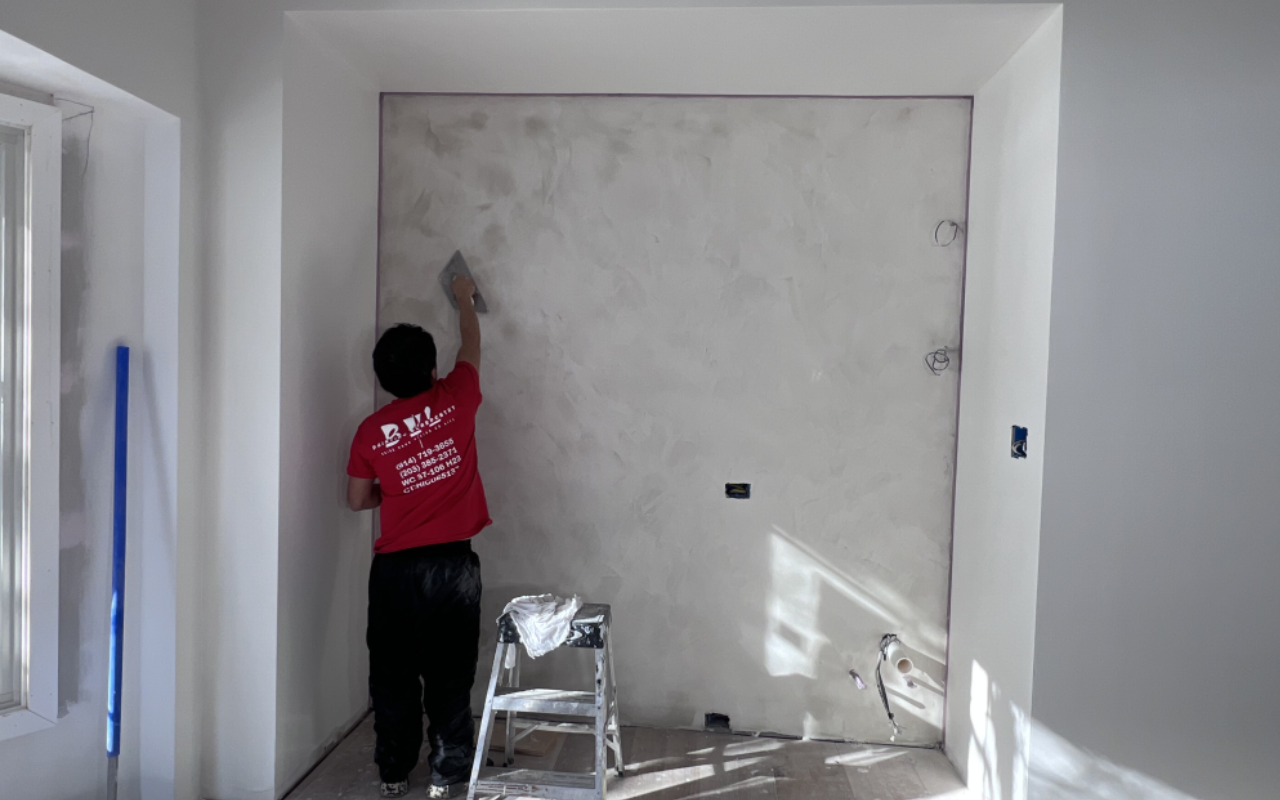
Venetian plaster gives walls a depth that paint cannot copy, and it suits the entry halls, dining rooms and powder rooms of many Greenwich homes. Before choosing it, you can request a finish consultation to see if it fits your space.
Light moves across the surface, and the finish can look like polished stone or soft suede depending on how it is applied.
What Makes This Lime and Marble Finish Special?
Traditional Venetian-style plaster is made from lime and marble dust. It is applied in thin layers with a steel trowel, then burnished to a soft or high sheen.
Because each layer is hand-troweled, no two walls look exactly alike. Modern acrylic versions offer a similar look with easier application.
The burnishing step compresses the surface, which creates the soft glow. Pigment is mixed into the plaster itself, so color runs through each layer rather than sitting on top.
Key Benefits of a Hand-Troweled Plaster Finish
- Depth and movement that change with the light
- Seamless surface with no visible joints
- Durable, hard finish once cured
- Lime-based versions resist mold naturally
- Can be tinted to almost any color
Lime-based plaster also lets walls breathe, which helps in older homes with changing humidity. In Greenwich, the finish is chosen most for foyers, formal dining rooms and powder rooms, where guests notice it right away.
Downsides to Consider Before Choosing Polished Plaster
The finish is beautiful but not for every project. To understand how these limits apply to your rooms, you can ask about polished plaster before deciding.
| Downside | What it means | How to manage it |
|---|---|---|
| Labor-intensive | Multiple thin coats and burnishing | Plan more time than paint |
| Skill-dependent | Poor technique shows clearly | Hire experienced applicators |
| Hard to touch up | Patches can show | Keep leftover tinted material |
| Needs a smooth base | Wall flaws can telegraph | Proper drywall prep first |
Rooms with many outside corners need extra planning, since edges take the most wear.
Can You Apply a Polished Plaster Finish Yourself?
At BVL Painting & Carpentry, we start every plaster project with sample boards, so you can approve color and sheen in your own light.
Small practice boards are a good way to learn, but full walls are difficult. The trowel angle, pressure and timing between coats decide the final look.
Most homeowners choose a professional for main living areas and save DIY experiments for small accent pieces. Trowel marks or burnished patches are hard to fix once the plaster cures.
What Affects the Cost of a Plaster Wall Finish?
It generally costs more than standard paint because of the material and hours involved. Each coat must cure before the next one goes on. The final price depends on wall size, condition, number of coats, sheen level and whether you choose lime or acrylic plaster.
Ceilings, curved walls and stairwells usually add time because they are harder to trowel evenly. A site visit is the only way to get a clear number.
Polished Plaster Versus Paint and Other Wall Finishes
Each finish has a place in a well-designed home. Paint is faster and easier to change. Wallpaper offers pattern, while plaster offers texture and depth without seams. Limewash gives a softer, chalky texture. polished plaster sits at the high end, with more depth and polish.
Our guide to wall finish options compared covers more alternatives.
Some clients combine finishes, using polished plaster on a feature wall and durable paint on surrounding walls to balance cost and impact.
Caring for Plaster Walls Over Time
- Dust with a soft cloth and avoid harsh or acidic cleaners.
- Wipe spills promptly with a soft, damp cloth and dry the area.
- Apply a protective wax in high-touch areas if recommended.
- Call a professional for chips or cracks instead of patching with drywall compound.
Avoid tape, adhesive hooks and abrasive sponges on finished walls, since they can pull or dull the surface.
At BVL Painting & Carpentry, we recommend keeping a labeled sample of the tinted material for future touch-ups. Lime finishes can develop a soft patina over time, which many homeowners consider part of their character.
Specialty Finishes in Greenwich and Fairfield County
Our team handles specialty finishes alongside interior painting, wallpaper and carpentry.
Our crews bring more than a decade of hands-on experience and are fully licensed and insured in CT and NY for residential and commercial projects (WC: 37-106 H23 / CT: HIC0651374). At BVL Painting & Carpentry, we also offer bilingual service in English and Spanish.
Explore our specialty finishes for interiors or our Greenwich interior painting services.
Frequently Asked Questions
Is polished plaster durable?
Yes. Once cured, it forms a hard surface that lasts for many years with light care. Small marks can often be buffed out.
Can polished plaster go in a bathroom?
Yes, with the right product and a protective sealer for wet areas. Powder rooms are one of the most popular places for it.
Can it be applied over drywall?
Yes, once the drywall is smooth and properly primed. Cracks and seams should be repaired first.
How long does it take to apply?
It depends on wall size and coats, but expect more time than standard paint. Most rooms take several days.
Do you offer free estimates?
Yes. We work Monday to Friday, 9:00 AM to 5:00 PM, and estimates are free. You can also text us at (203) 385-2371.
A Finish That Adds Lasting Character
Venetian plaster brings depth, durability and individuality to the rooms where it is used well. Choosing the right rooms and an experienced applicator makes the difference. Seeing samples in your own light is the best place to start.
Call (914) 719-3655 or plan your plaster finish today.